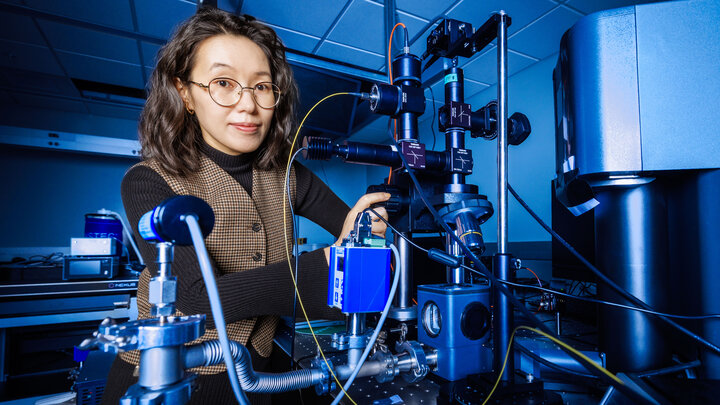
Yanan (Laura) Wang, a rising researcher in quantum photonics and advanced materials, has been chosen to receive two major honors that recognize her achievements.
Wang, assistant professor of electrical and computer engineering, was named a senior member of Optica, the leading organization for engineers, scientists and others interested in the science of light. The organization was formerly known as the Optical Society of America.
The 2025 Optica Senior Members, which recognizes contributions in government, academia and industry, was awarded to a class of 72 individuals in 21 countries. It recognizes Wang for more than a decade of contributions to optical science, device engineering and quantum technology.
Wang was also inducted to the Early Career Board 2025 for Nano Letters, one of the top journals in the fields of nanoscience and nanotechnology. The most recent class included 55 of the top researchers from 16 countries.
“My current research stems from the work I pursued during my Ph.D. study and expanded through my postdoctoral experience,” Wang said. “Photonics is related to light and optical phenomena, and phononics is related to acoustic and mechanical vibrations. Bringing them together builds the foundation for what we’re doing now in the Quantum Photonics and Phononics Lab at UNL.”
A central goal of her work is enabling quantum functionality at room temperature. Many existing quantum computers rely on superconducting systems that must operate at extremely low temperatures. Photonic systems, however, can preserve quantum properties without such extreme cooling. Wang’s team works to develop the photonic components needed to form integrated quantum circuits — advancing beyond individual quantum light sources toward fully functional systems.
“We’re trying to develop quantum devices or quantum functionality that can work at room temperature,” she said. “The same photonic circuit structures used in classical optics, such as waveguides and resonators, can also be used to control quantum states of light. Our goal is to leverage those platforms to manipulate single photons and explore quantum phenomena.”
Her research also carries powerful near-term applications. Compared to traditional electronic circuits, photonic devices operate at far higher frequencies and bandwidths because photons travel at the speed of light and offer multiple ways to encode information. Optical circuits can even perform operations, such as matrix multiplication for neural networks and Fourier transforms for signal processing, directly on-chip and in real time.
“Photonics has intrinsic advantages,” Wang explained. “Photons move faster than electrons, and we can encode information in many different ways. That gives us much broader bandwidth and much higher communication speed.”