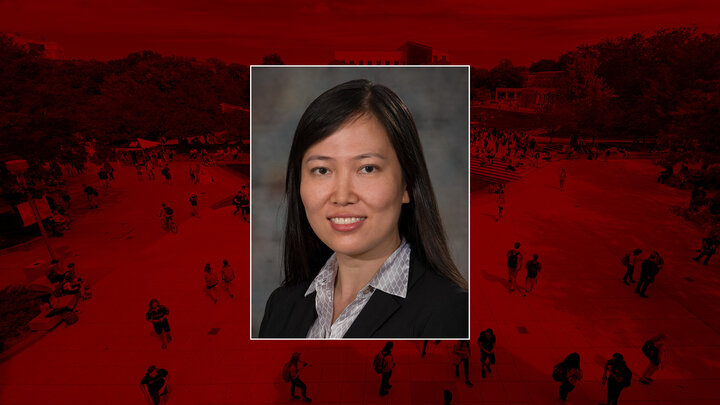
Bai Cui, professor of mechanical and materials engineering, has been named a Fellow of the American Ceramic Society (ACerS), one of the most prestigious honors in the field of ceramic materials and engineering and, according to available records, the first UNL faculty member to receive this distinction. Established in 1898, ACerS is one of the world’s leading professional societies dedicated to ceramic materials and engineering and serves as a major forum for advancing research, education, and technological innovation in the field.
This honor is awarded annually during the ACerS Annual Meeting to individuals whose contributions have significantly advanced ceramics research, education, and application, and selection is reserved for leaders whose work has shaped the direction of the discipline.
Cui’s career has been defined by influential research across multiple areas of ceramic materials, including ultra‑high‑temperature ceramics, additive manufacturing of ceramic materials, and the development of advanced ceramics for extreme environments. His work has helped expand the fundamental understanding of how ceramic systems behave under extreme thermal, chemical, and mechanical stress—knowledge essential to innovations in aerospace protection systems, nuclear energy technologies, and next‑generation manufacturing.
Cui leads the Materials for Extreme Environments Laboratory, where his team develops advanced materials using compositionally complex (“high‑entropy”) and microstructure‑design concepts to withstand extreme heat, corrosion, and irradiation. His group published the first peer‑reviewed study on compositionally complex carbides and later demonstrated their exceptional resistance to irradiation. They also innovate laser‑based processing technologies, including selective laser sintering for ceramics and a patented high‑temperature laser shock peening system that enhances material performance.
Through both experimental and computational approaches, he has produced findings that have strengthened the reliability, performance, and design of ceramics used in demanding industrial and scientific applications.
The election of ACerS Fellows is based on sustained excellence, documented impact, and professional leadership. Fellows are nominated by peers and evaluated on research achievements, contributions to the international ceramics community, and service that advances the society’s mission. Yusong Li, associate dean for faculty in the College of Engineering, and Katie Romey, external recognition and awards coordinator in the university’s Office of Research and Innovation, played key roles in supporting Cui’s nomination.
At Nebraska, Cui has also distinguished himself as a mentor and collaborator, guiding graduate students and building interdisciplinary partnerships that elevate the College of Engineering’s profile in materials science. He has also been active in ACerS, serving as Chair of the Manufacturing Division (2025–26) and in multiple other leadership roles within the Society, while helping organize numerous conferences and symposia and advancing professional engagement within the ceramics community. His election as an ACerS Fellow underscores both his global influence and Nebraska’s growing leadership in advanced materials research.