Mother Nature builds the most spectacular highways—so precise and efficient that water and ions glide through them in flawless choreography. We call these wonders ion channels. But are man-made ion pathways anywhere close to matching that elegance? The simple answer is: No, Not yet.
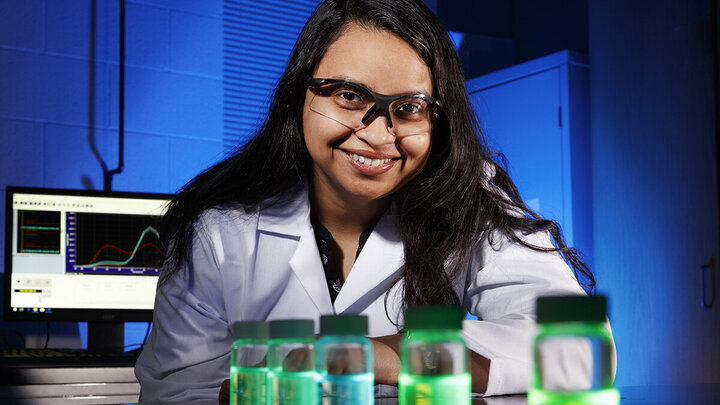
At Nebraska Engineering, Shudipto Dishari is drawing inspiration from nature’s blueprint and pioneering a new design philosophy for artificial ion channels—one that could reshape next-generation energy technologies and ignite breakthroughs across myriads of fields.
Armed with a 3.5-year, $886,000 grant from the U.S. Department of Energy’s Basic Energy Sciences program, Dishari is leading a bold effort to engineer ultrathin polymer layers aimed to precisely channel ions toward catalyst particles on electrodes.
“All electrochemical devices rely heavily on ion transport, but right now, we rely too much on chance, “ said Dishari, the Ross McCollum Associate Professor of Chemical and Biomolecular Engineering. “The chance to get transported because the roads formed for them via spontaneous phase separation are often random, zigzag, and unpredictable. We have some control, but not the level of control we truly need.”
“Instead of leaving ions to wander, through this DOE grant, we will design ionomers that self-assemble into orderly and predictable pathways- almost like building highways at the nanoscale on purpose rather than by accident.”
“We’ll stack ionomers piece by piece to create customized, planned, and repeatable ion channels.” She explained. “Imagine a pyramid of stacked cups, each with carefully cut holes. When you pour water into the top cup, the flow pattern depends entirely on the size, position, and number of those holes. Change the parameters and the flow changes. That’s how we want to direct ions—systematically, controllably, efficiently.”
This vision didn’t arise out of thin air. Dishari began shaping it during her DOE Office of Science Early Career Award, where she demonstrated that nature-inspired ionomers can work wonders: rapidly transporting ions and addressing long-standing challenges in electrode design. Her early breakthroughs have appeared in JACS Au, Cell Reports Physical Science, and beyond.
One of nature’s most elegant ion channels — gramicidin — serves as a powerful source of inspiration for her.
“Gramicidin operates using a beautifully organized assembly of proteins that form an efficient pathway for ions,” Dishari said. “I want to bring that capability of precision into synthetic energy materials. With our design principles, we won’t be at the mercy of however the material happens to form. We can build the channels we want, exactly the way we want them.”
As a basic science endeavor, Dishari said, this approach opens a bold, disruptive, forward-looking design space for ionomer materials that stands apart from current concepts of ionomer and electrode architecture.
“This innovation has the potential to ripple across many technologies from batteries, fuel cells, electrolyzers, electrodialyzers to artificial ion pumps for drug delivery, bioprotonic devices, artificial ATP synthesis constructs, neuromorphic electronics, and more," Dishari said.
“We are creating an exciting new design frontier — one that positions Nebraska in the national energy innovation landscape."