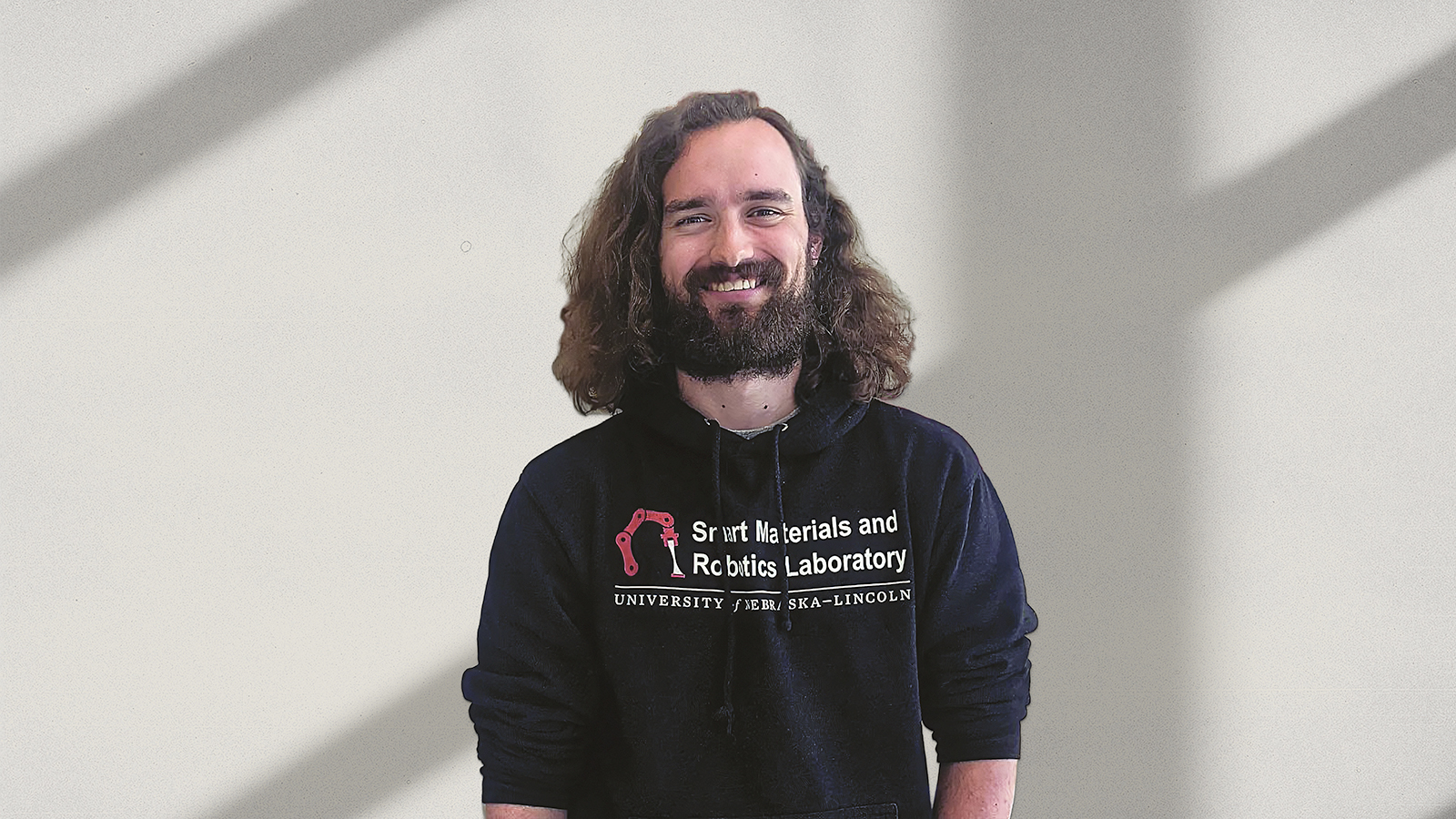
When Patrick McManigal started as a computer engineering major at the University of Nebraska–Lincoln, he never imagined his future research would involve creating a device capable of smelling disease. But today, the Millard North graduate and entrepreneurial Ph.D. student has developed what he calls an Electronic Nose – a wearable, battery-free sensor that could one day help detect early stages of cancer, diagnose respiratory illnesses, and even keep workers safe from exposure to hazardous chemicals.
McManigal’s path to discovery began in an unexpected way: discovering what he wanted to do amid a pandemic.
“I was a sophomore, and I was looking for a job on campus during COVID,” he said. “Eric Markvicka was looking for undergraduate researchers in his lab, and that’s really how it all started.”
Markvicka, the Robert F. and Myrna L. Krohn Associate Professor of Biomedical Engineering, was leading research on soft, skin-like electronics. Under his mentorship, McManigal joined a team exploring how stretchable and flexible sensors could monitor environmental and biological conditions. What began as a project to detect airborne chemicals soon evolved into something far more promising.
Through a collaboration with the University of Nebraska Medical Center, the team realized the technology’s potential for remote health monitoring. Humans constantly emit trace chemicals through skin and breath — the same types of scents that trained dogs can use to detect diseases like cancer. The team adapted their design to sense these compounds, creating a thin, sticker-like device that can “sniff out” volatile organic compounds linked to illnesses such as colon cancer and Clostridium difficile (C. diff) infections.
“The big thing we introduced was a sensor that could passively and reversibly interact with chemicals excreted through human skin,” said Markvicka. “Our hope is that this sensor could become an early warning sign that prompts someone to see their doctor before conditions progress.”
The Electronic Nose has already drawn national attention. McManigal and the Nebraska team were named one of three winners at the DMD 5MP (Five-Minute Pitch) Competition at the Design of Medical Devices Conference in Minneapolis for their presentation, “Wireless, Battery-Free Wearable Electronic Nose.”
The small, flexible patch works thanks to tiny “gas sponges” that absorb and respond to specific chemicals. When connected to a smartphone, the sensors wirelessly harvest power, measure the sensors, then transmit data to a mobile app — offering a noninvasive, low-cost way to monitor health from home.
Beyond medicine, McManigal sees potential applications in agriculture and workplace safety. For example, farmers could use the device to monitor herd health, while industrial workers could wear it to detect dangerous chemicals such as ammonia, a common compound linked to respiratory and skin irritation.
“Through customer discovery, we found that the market for colon cancer screening is wide open, but so are other areas where exposure monitoring is critical,” McManigal said. “Our device could fill those gaps in a way that’s affordable and accessible.”
Through NIH funding from the National Center for Complementary and Integrative Health, the team is now preparing for clinical trials, an important step toward real-world testing. For McManigal, who once joined a college research lab just to find part-time work, the experience has turned into a mission.
“It’s been exciting to see something that started as an academic project evolve into technology that could genuinely improve lives,” he said.