For six months from May to October 2025, South Korean researcher Dohyeon Jeon made the University of Nebraska-Lincoln College of Engineering his home base while pursuing an answer to a deceptively simple question: How quickly does a tiny droplet of water dry?
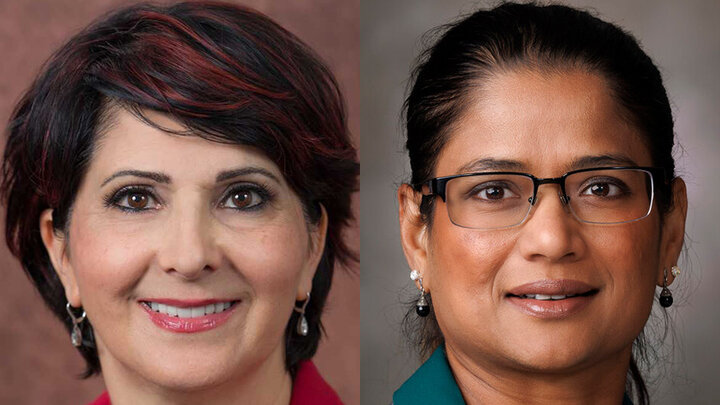
Jeon, a Ph.D. engineering student at Sungkyunkwan University (SKKU) in South Korea, came through a South Korean government-funded international collaboration grant secured by his advisor at SKKU. The project pairs Jeon’s experimental work with advanced simulations led by Jae Sung Park, Richard L. McNeel Associate Professor in Mechanical and Materials Engineering at UNL. This international collaboration was made possible thanks to Park’s Faculty Development Fellowship in South Korea for AY2024/25.
At first glance, the research seems familiar.
“Think about drying your hair after taking a shower,” Park said. “You blow the air, and the water evaporates.”
But beneath that everyday experience lies complex physics.
Jeon’s experiments focus on a single droplet of water — roughly three microliters in volume and only a few millimeters wide — exposed to controlled airflow. Though small enough to sit on the tip of a finger, the droplet contains a dynamic world of fluid motion that is nearly impossible to see directly.
“Fluid motions are hard to visualize,” Jeon explained. “That’s why we must rely on simulations.”
That’s how Jeon came to Nebraska to tap the expertise of Park and his lab.
Working with Jeon’s advisor at SKKU, Professor Byung Mook Weon, Jeon measured evaporation rates under varying air speeds and temperatures, capturing the process with high-resolution cameras. In Lincoln, he worked with Park’s group to develop numerical models that simulate how air flows around the droplet as it evaporates. Together, they created what Park describes as a “design map” — a predictive model that estimates how quickly a droplet will dry under specific conditions.
While airflow is known to accelerate evaporation, the team sought to quantify exactly how much — and why.
The implications extend far beyond hair dryers. Many industries rely on drying processes, from painting and coating to semiconductor manufacturing. Heat is often used to speed evaporation, but excessive temperatures can damage delicate materials. Airflow offers an alternative — if engineers understand how to use it efficiently.
“To minimize cost without applying heat, we can rely on airflow,” Park said. “That’s the starting point of our question.”
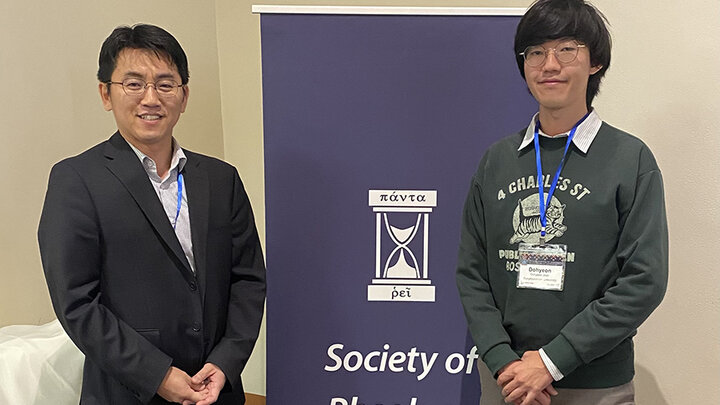
The collaboration has already produced one published paper, with a second underway. In addition, Jeon presented at the Society of Rheology Annual Conference in October held in Santa Fe, New Mexico.
Jeon considers his visit to UNL a success, though cautiously.
“I got the data I wanted to publish,” he said. “It’s not a perfect victory, but worth a toast.”
Beyond research, Jeon found Lincoln unexpectedly memorable. Having visited cities such as Salt Lake City, New York and Santa Fe during his stay, he still preferred Lincoln’s quiet pace.
“I have never experienced this level of tranquility before,” he said. “Personally, Lincoln was the best place.”
Upon departing for home in October, Jeon carried with him data, new models and an expanded international partnership — proof that even a single droplet can build global connections like those Park hopes will expand in the near future.
“It would awesome to bring more young talent to our campus to expose them to the research possibilities that we can offer here,” Park said. “I like building up the international collaborations, and I'm super excited that hopefully we can have more in the near future”