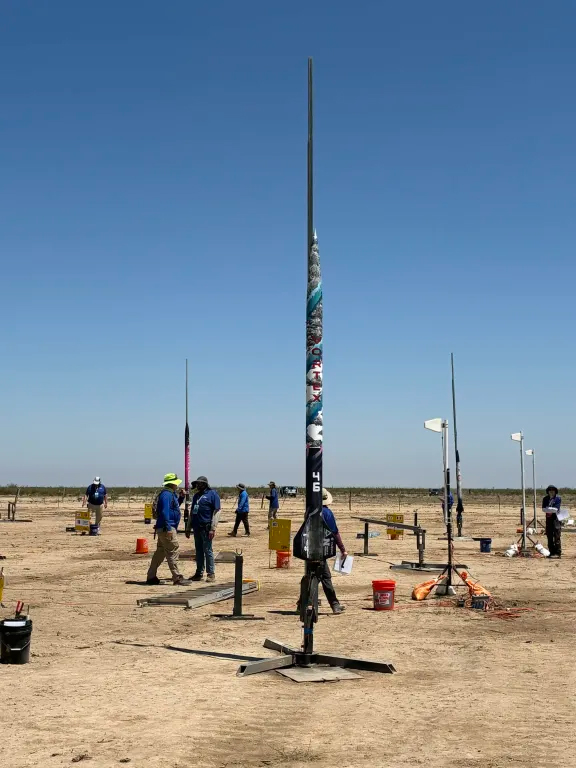
The team of engineering students placed seventh overall and fourth in the 10K Commercial Off-the-Shelf category at the International Rocket Engineering Competition (IREC) in Midland, Texas, the best finish in Husker Rocketry history. Their rocket, VORTEX, flew 9,693 feet, reached a speed of Mach 0.8 and achieved 26.7Gs carrying a payload.
“They built an entire rocket and made it fly, all within eight months,” said Rachael Wagner, team adviser since 2024 and assistant professor of practice in mechanical and materials engineering and robotics engineering. “The lessons they learn are so valuable. I can see firsthand how it helps them in classes and helps them solve real-world problems.”
Husker Rocketry is part of Nebraska’s Aerospace Club, a student organization that includes six design teams: Design, Build, Fly; Lunabotics; Rocketry; UAV (Unmanned Aerial Vehicles); Rocket Propulsion; and AXP (Aerospace eXperimental Payloads), which contributed to the success of Big Red Satellite’s NASA launch in 2024. The club has grown to about 150 members, creating a student network interested in aerospace, mechanical systems, propulsion, manufacturing and flight operations.
That membership growth was significant this year, according to Wagner. After many experienced leaders graduated, sophomore and junior students stepped into roles that required technical judgment, project management and long hours of collaboration. Members 18 and older also must be certified through the Tripoli Rocketry Association to participate in high-powered launches.
“There were a lot of sophomore and junior students who had to step up and fill those leadership positions,” Wagner said. “They learned a lot, made some great decisions and gained a lot of valuable experience. I’m excited to see what they can do the next couple of years.”
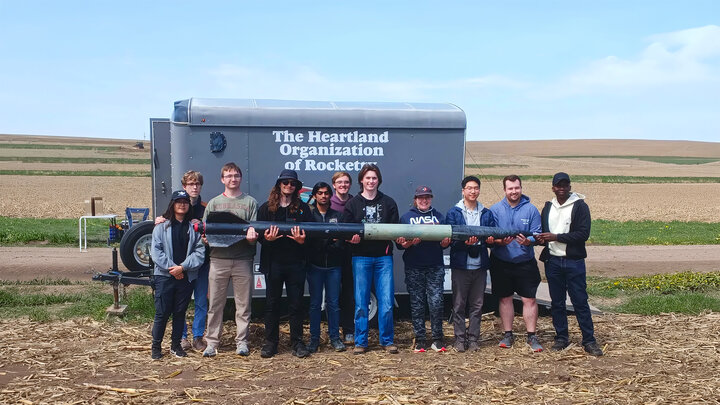
Standing 11 feet tall, VORTEX was built to compete in a category that challenges teams to fly as close as possible to 10,000 feet while carrying a payload. The team’s final altitude reflected a series of improvements made after an April test launch with The Heartland Organization of Rocketry (THOR), including sanding the airframe and beveling edges to improve aerodynamics.
“We spent the first half of the school year researching and refining our composite manufacturing process,” said Killian Haecker, a junior mechanical engineering major who is the team’s social media and marketing lead and co-airframe lead. “There were definitely setbacks along the way, with several composite layups not meeting our standards or getting stuck on our mandrels, but those challenges ultimately helped us improve our design and manufacturing techniques.”
Haecker said one of the team’s major milestones was bringing a Student Researched and Designed (SRAD) airframe to competition for the first time. VORTEX was also completed earlier than in previous years, giving the team valuable time to test and refine the rocket before traveling to Texas. The avionics group quickly learned to wire, program and operate the rocket’s flight computers, while the payload team designed the team’s first custom printed circuit boards and built a rotating tracking dish that streamed live footage of the competition flight for IREC staff.
The team’s IREC finish places Husker Rocketry among the top collegiate rocketry programs in a competition that draws university teams from around the world. The 2026 event brought together 144 university teams from an initial applicant pool of 196, according to the Experimental Sounding Rocket Association, which announced the official results in July.
Wagner said the students’ commitment is part of what makes the Aerospace Club successful. Since members pay dues, which she said gives them “skin in the game,” it contributes to an “ownership culture of motivation and accountability.”
“Everyone was willing to learn, put in extra hours and help wherever needed,” Haecker said. “Seeing the team come together, overcome setbacks and ultimately achieve one of our best competition performances made the experience incredibly rewarding.”