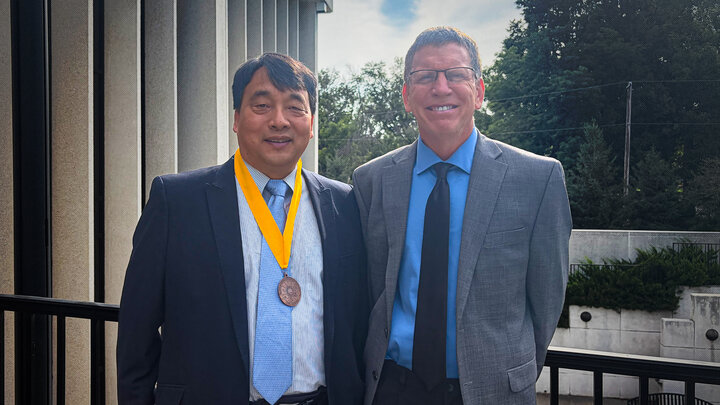
Jian Wang, professor of mechanical and materials engineering, has been selected by the University of Nebraska President’s Office as a recipient of the prestigious 2026 Outstanding Research and Creative Activity (ORCA) Award.
Established in 1978, the ORCA award is the university system’s premier research honor, recognizing faculty whose national and international contributions have fundamentally advanced their fields. The honor includes a $10,000 stipend.
Wang, the Wilmer J. and Sally L. Hergenrader Presidential Chair in mechanical engineering, is the third Nebraska Engineering faculty member to be chosen, joining Ezekiel Bahar (1980) and Yongfeng Lu (2017).
"Receiving the ORCA award is a profound honor that validates our team's dedicated effort to pushing the boundaries of materials science," said Wang. "It reinforces our commitment to developing next-generation structural materials that can withstand the world's most demanding environments."
In his Multiscale Interfaces Design in Solids (MINDS) lab, Wang directs research that relies on his dual background in solid mechanics and mechanical engineering. His team combines atomistic modeling with multi-scale experimental techniques to unlock the "structure-properties relationship" of nanostructured materials. By understanding how atomic defects, crystal boundaries, and dislocations interact, Wang develops foundational principles for tailoring metals and composites to achieve specific behaviors under extreme pressure or radiation.
"Ultimately, our goal is to eliminate the guesswork in materials design," Wang said. "Instead of relying on trial and error, we are building physics-based predictive tools. This allows us to map out and engineer materials from the atom up, giving them precise characteristics like enhanced ductility, greater strength, or extreme damage resistance."
Among the many projects and areas of interest he is working on, Wang said he is particularly focused on the future of nuclear energy.
“It’s making a comeback over the past decade and is a big opportunity for students to pursue,” Wang said. “Energy is a big challenge for the whole country and the world, and nuclear energy is still very powerful and is safe overall. The (federal) and state governments are looking more at this, which will create a need for more nuclear engineers and engineering in general.”
At UNL, Wang's relentless curiosity has translated into extraordinary scholarly output – yielding more than 250 published papers, according to Google Scholar, and nearly 28,000 citations.
Wang credited the collaborative environment at Nebraska and his enduring fascination with atomic structures for sparking his productivity and his passion about the future of materials science and engineering.
"What keeps me energized is the thrill of discovery," Wang said. "Every time we look at how these tiny nanoscale interfaces behave under extreme conditions, we find something new. Passing that spark of curiosity down to young researchers in the lab is what truly fuels this work."