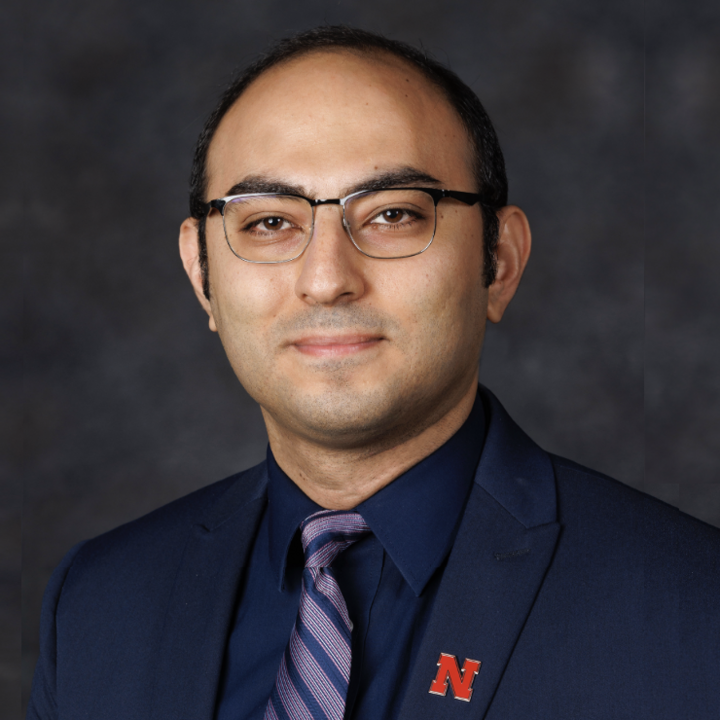
Milad Roohi
Assistant Professor; Director of Smart Resilient Infrastructure and Urban Systems (SiRIUS) Lab; College of Engineering Teaching Fellow Durham School of Architectural Engineering and Construction University of Nebraska-Lincoln
Contact
- Address
-
101B Peter Kiewit Institute (PKI)
Omaha, Nebraska 68182 -
milad.roohi@unl.edu
- Website
-
Smart Resilient Infrastructure and Urban Systems (SiRIUS) Lab
- Website
-
Google Scholar
- Social Media
Dr. Milad Roohi is an Assistant Professor in the Durham School of Architectural Engineering and Construction at the University of Nebraska–Lincoln and director of the Smart Resilient Infrastructure and Urban Systems (SiRIUS) Lab. His research combines infrastructure resilience, structural health monitoring, and artificial intelligence to support decisions about risk mitigation and recovery from natural hazards.
His work connects sensing and computational models with community data to assess the performance of buildings, infrastructure networks, and interdependent urban systems. His research has received support from federal, state, and university programs, including NSF, NIST, NASA EPSCoR, the U.S. Department of Transportation, and the Nebraska Department of Transportation.
A College of Engineering Teaching Fellow, Dr. Roohi teaches undergraduate and graduate courses in structural engineering and infrastructure resilience. Before joining Nebraska, he was a Senior Scientist at Aon’s Impact Forecasting Catastrophe Modeling Center of Excellence and a postdoctoral fellow at Colorado State University’s NIST Center for Risk-Based Community Resilience Planning.
Explore SiRIUS Lab research, education, and outreach · View publications on Google Scholar
Education
- Postdoctoral Fellow – National Institute of Standards and Technology (NIST) Center for Risk-Based Community Resilience Planning, Colorado State University (2021)
- Ph.D., Civil and Environmental Engineering – University of Vermont (2019)
- M.Sc., Civil and Environmental Engineering – University of Tehran (2014)
- B.Sc., Civil and Environmental Engineering – K. N. Toosi University of Technology (2011)
Research, Education, and Outreach at SiRIUS Lab
- Visit our Smart Resilient Infrastructure and Urban Systems (SiRIUS) Lab website for more on our research, education, and outreach initiatives.
Research Interests
The Smart Resilient Infrastructure and Urban Systems (SiRIUS) Lab investigates how data, algorithms, computational models, and emerging technologies enhance the performance, monitoring, and resilience of civil infrastructure and urban systems exposed to deterioration, natural hazards, and climate change. This research is supported by the National Science Foundation (NSF), National Institute of Standards and Technology (NIST), Transportation Research Board's Airport Cooperative Research Program, NASA EPSCoR, U.S. Department of Transportation through the Mid-America Transportation Center, the Nebraska Department of Transportation, the Nebraska Research Initiative, UNL Grand Challenges, and Durham School Seed Grants.
Research interests encompass the following interconnected areas:
- Multi-hazard resilience and interdependent community systems, including co-creation of strategies for infrastructure networks and socio-technical systems.
- Structural dynamics, reliability, performance, and functional recovery under time-varying, stochastic, and multi-hazard loads.
- Sensing, data fusion, and Digital Twins for monitoring and managing the condition of cyber-physical infrastructure systems.
- Emerging technologies for smart, resilient cities, including IoT, GeoAI, edge computing, computer vision, and virtual/extended reality.
- Artificial intelligence, probabilistic learning, and estimation applied to natural hazard analysis and infrastructure risk assessment.
- Design, testing, and assessment of next-generation resilient structural systems, with emphasis on performance-based and recovery-based engineering.
- Computational structural mechanics and nonlinear finite element analysis for modeling complex behavior of materials, components, and systems.
Academic and Professional Appointments
- Assistant Professor, Durham School of Architectural Engineering & Construction, University of Nebraska–Lincoln (2022–Present)
- Senior Research Associate, National Institute of Standards and Technology (NIST) (2024–Present)
- Associate Research Scientist, Johns Hopkins University (2024–2025)
- Community Resilience Specialist, Project IN-CORE, Community Initiatives (2024–Present)
- Senior Scientist, Aon, Reinsurance Solutions, Impact Forecasting Catastrophe Modeling Center of Excellence, Chicago, IL (2021–2022)
- Research Affiliate, Department of Civil and Environmental Engineering, Colorado State University (2021–2023)
- Postdoctoral Fellow, NIST Center for Risk-Based Community Resilience Planning, Colorado State University (2019–2021)
- Graduate Research Assistant, Structural Monitoring, Diagnostics & Prognostics Lab, University of Vermont (2015–2019)
- Graduate Research Assistant, Center of Numerical Methods in Engineering (CNME), University of Tehran (2011–2015)
Courses Taught
- MECH 223 Engineering Statics (Fall 2022, 2023, 2024, 2025)
- AREN 851 Masonry and Timber Design (Fall 2024, 2025)
- CIVE 459/859 Reliability of Structures (Spring 2023, 2025)
- AREN 4940/8940 Infrastructure and Community Resilience (Spring 2024, 2026)
- ENGR 491/891 Improvisation Skills for The Complete Engineer (J-Term 2024)
Distinctions and Awards
- 2026 Empowering Community Resilience Award, National Voluntary Organizations Active in Disaster (VOAD) & Walmart
- 2026 Learning From Earthquakes Reconnaissance Scholar, EERI/NCREE Taiwan
- 2025 IABSE People and Paper Award, International Association for Bridge and Structural Engineering
- 2025 Editor's Choice Selection Paper, ASCE Journal of Structural Engineering
- 2025 College of Engineering Teaching Fellow, University of Nebraska–Lincoln
- 2025 Systems Thinking Faculty Fellow, USDA Higher Education Challenge
- 2025 Honorable Mention / Certificate of Distinction, EOS OpenSees Research & Innovation Awards
- 2025 Invited U.S. Delegate, Inaugural NSF–NIED (Japan) Research Collaboration Meeting
- 2024 Invited Discussant, NSF TIP Directorate
- 2023 NSF CMMI Panel Fellow, Game Changer Academies
- 2023 Research Development Fellow (Prem S. Paul New Faculty Scholar), University of Nebraska–Lincoln
- 2023 Excellence in Teaching Recognition, UNL College of Engineering (also awarded in 2025)
- 2022 Structural Health Monitoring Recognition, ASCE Journal of Engineering Mechanics
- 2022 College of Engineering Research Fellow, University of Nebraska–Lincoln
- 2022 Joyce R. Jeffries New Faculty Scholar Award, UNL Office of Research & Innovation
Research Funding Record
Externally Funded Research
- NSF POSE Phase II (Co-PI, 2026–2028): Collaborative award with Colorado State University.
- NSF EPSCoR Research Fellows (Co-PI and UNL Host, 2025–2027): Collaborative award with Montana Technological University.
- Nebraska Department of Transportation (Co-PI, 2023–2027)
- Mid-America Transportation Center, U.S. Department of Transportation (PI, 2024–2026)
- NSF CIVIC-PG Track A (Co-PI, 2024–2025)
- Center for Cooperative Media, Montclair State University (Co-PI, 2025–2027)
- NASA EPSCoR (PI, 2024–2025): Collaborative award with University of Nebraska Omaha.
- National Institute of Standards and Technology (2024–2025): Professional Research Experience Program.
Internally Funded & Other Research Support
- University of Nebraska Collaboration Initiative / Nebraska Research Initiative (PI, 2026–2027)
- UNL Grand Challenges Catalyst (PI & Co-PI, 2024–2026)
- UNL Durham School Seed Grants (PI & Co-PI, 2023–2026)
- National Quantum Laboratory, University of Maryland (2026): IonQ Quantum Processing Unit access credits.
Professional Service & Leadership
Editorial & National Leadership
- Associate Editor: The Monitor, Society for Civil Structural Health Monitoring (2026–2028).
- Committee Chair: ASCE Objective Resilience Committee (2025–Present); Construction Technical Committee, ASCE Nebraska Section (2025–Present).
- Leadership Teams: International Association on Multidisciplinary Resilience (Young Regional Representative, USA); ASCE Special Project on Enhancing the Role of Structural Engineers in Catastrophe Modeling.
- Technical Committees: Active member of IABSE Task 1.8, NAAHDRI, ISCM, and multiple ASCE EMI committees (Dynamics, SHM & Control, Probabilistic Methods).
Peer Review & Panel Service
- National Panelist: NSF Proposal Review Panels (CISE, Geosciences, RISE Division, NSF–NIST, and CMMI) and USDOT University Transportation Center.
- Journal Reviewer: Active peer reviewer for leading journals including ASCE Journal of Structural Engineering, Journal of Engineering Mechanics, and Natural Hazards Review.
Conference Organization
- Special Sessions & Symposia: Organized and chaired sessions for major conferences including the 13NCEE (2026), NHERI Computational Symposium (2026), ASCE AEI/IRD (2026), and ICOSSAR (2025).
- Event Leadership: Lead Organizer for the Future of Building Industry (FoBI) Workshop (2023, 2025) and Host of the EMI Objective Resilience Lecture Series.
Public and Community Service
- Community Resilience Partnerships: Co-led unreinforced masonry vulnerability assessments for Salt Lake City's "Fix the Bricks" program using the IN-CORE platform, supporting over 160 completed retrofits.
- Regional Engagement: Co-Investigator for the UNL–City of Lincoln Research Partnership and Member of the ASCE Nebraska State Infrastructure Report Card Team.
- Student Mentorship: Faculty Advisor for EERI and AREMA student chapters; Mentor for the ASCE Future Cities Program.
Professional Memberships
- Associate Member, American Society of Civil Engineers (ASCE) (2015–Present)
- Member, Earthquake Engineering Research Institute (EERI) (2015–Present)
- Member, International Association on Multidisciplinary Resilience (IAMDR) (2024–Present)
Selected Publications
Selected journal articles, book chapters, conference papers, and manuscripts under review are listed below. Visit Google Scholar for the current publication record and citation metrics.
Ph.D. Dissertation
Roohi, M. (2019). Performance-Based Seismic Monitoring of Instrumented Buildings. Ph.D. Dissertation, University of Vermont, Graduate College Dissertations and Theses. 1140. [Link: https://scholarworks.uvm.edu/graddis/1140]
Book Chapters
- Roohi, M., Ghasemi, S., & van de Lindt, J. W. (2026). Resilience Modeling for Community-Level Decision-Making. Accepted; in production.
- Sedaghati, F., Roohi, M., Bastami, M., Abbasnejadfard, M., Motamed, H. (2026). Seismic Risk Application in Insurance. In M. Kowsari & B. Halldorsson (Eds.), Recent Advances in Earthquake Hazard and Seismic Risk Assessment (Springer Nature).
- Roohi, M., & Hernandez, E. M. (2026). Post-Seismic Structural Health Monitoring of Buildings. In V. Karbhari & F. Ansari (Eds.), Condition Monitoring and Structural Health Monitoring of Infrastructure Systems (Chapter 13, pp. 387–430). Woodhead Publishing Series in Civil and Structural Engineering. Invited contribution to the second edition. https://doi.org/10.1016/B978-0-443-38315-1.00008-8
- Roohi, M., Behnam, B., Farahani, S., Shojaeian, A. (2023). Seismic Multi-hazard Risk and Resilience Modeling of Networked Infrastructure Systems (Chapter 18). Automation in Construction Toward Resilience: Robotics, Smart Materials & Intelligent Systems, Taylor & Francis, London, UK.
- Roohi, M., Hernandez, E. M., Rosowsky, D. (2019). Nonlinear Seismic Response Reconstruction in Minimally Instrumented Buildings Validation using NEESWood. Structural Health Monitoring 2019, Enabling Intelligent Life-cycle Health Management for Industry Internet of Things (NOT). [DOI: https://www.dpi-proceedings.com/index.php/shm2019/article/view/32390]
Journal Manuscripts Under Review
- Palit, T., Ghasemi, S., González, A. D., & Roohi, M. A Chance-Constrained Optimization Framework for Addressing Bounded Risk Exposure in Building Retrofitting Decisions against Natural Hazards. Reliability Engineering & System Safety.
- Adhikari, P., Roohi, M., Wood, R. L., & Roueche, D. B. Assessing Predictive Accuracy of Tornado Resilience Models Through Post-event Reconnaissance Data Analysis. Natural Hazards Review.
- Hernandez, E. M., Adhikari, P., & Roohi, M. Redefining the Seismic Margin of Safety from Uniform Scaling to Minimum Perturbation. Earthquake Engineering & Structural Dynamics.
Refereed Journal Papers
- Zannat, N. T., Sen Gupta, H., Ghasemi, S., Nicholson, C. D., Cutler, H., González, A. D., & Roohi, M. (2026). Integrating ML-Based Reverse Engineering of CGE Models with Optimization for Enhancing Community Resilience. Natural Hazards Review (ASCE). Accepted.
- Ghasemi, S., Roohi, M., Sanderson, D., Sediek, O., & van de Lindt, J. W. (2026). Integrated Data Imputation of National Inventories for Bridging Information Gaps and Outcome Risk Uncertainty in Community Resilience Modeling. International Journal of Disaster Risk Reduction, 106077. [DOI]
- Cheraghzade, M., Deniz, D., & Roohi, M. (2025). Hospital Network Resilience in Hatay Following the 2023 Cascading Earthquakes in Türkiye: A Year-Long Investigation. Journal of Structural Engineering (ASCE) [IF: 4.1; DOI]
- Roohi, M., Ghasemi, S., Sediek, O., Jeon, H., van de Lindt, J. W., Shields, M., Hamide, S., Cutler, H. (2024). Multi-Disciplinary Seismic Resilience Modeling and Community Engagement for Developing Mitigation Policies. Resilient Cities and Structures. [IF: : 4.83; DOI]
- Sediek, O. A., Roohi, M., and van de Lindt, J. W. (2024). A Genetic Algorithm Framework for Seismic Retrofit of Building Portfolios to Enhance Community Resilience. International Journal of Disaster Risk Reduction, 104570. [Impact Factor: 5; DOI]
- Sediek, O., Roohi, M., and van de Lindt, J. W. (2024). A Decision Support Methodology for Seismic Design Requirements of Buildings to Achieve Community-level Resilience Metrics. ASCE-ASME Journal of Risk and Uncertainty in Engineering Systems, Part A: Civil Engineering. [Impact Factor: 3.084; DOI]
- Makhoul, N., Roohi, M., van de Lindt, J. W., Sousa, H., Oliveira Santos, L., Argyroudis, S., Barbosa, A., Derras, B., Gardoni, P., Sung Lee, J., Mitoulis, S., Moffett, B., Navarro, C., Padgett, J., Rincon, R., Schmidt, F., Shaban, N., Stefanidou, S., Tubaldi, E., Xenidis, Y., Zmigrodzki. (2024). Seismic resilience modelling of interdependent built environment for integrating SHM and emerging technologies in decision-making. Structural Engineering International. [Impact Factor: 1.292; DOI]
- Farahani, S., Shojaeian, A., Behnam, B., Roohi, M. (2023). Probabilistic Seismic Multi-hazard Risk and Restoration Modeling for Resilience-informed Decision Making in Railway Networks. Sustainable and Resilient Infrastructure. [Impact Factor: 3.94; DOI]
- Cheraghzade, M., Roohi, M. (2022). Deep learning for seismic structural monitoring by accounting for mechanics-based model uncertainty. Journal of Building Engineering, 104837. [Impact Factor: 7.144; DOI]
- Roohi, M., Erazo, K., Rosowsky, D., Hernandez, E. M. (2021). An extended model-based observer for state estimation in nonlinear hysteretic structural systems. Mechanical Systems and Signal Processing, 146, 107015. [Impact Factor: 8.934; DOI]
- Roohi, M., Hernandez, E. M., Rosowsky, D. (2021). Reconstructing Element-by-Element Dissipated Hysteretic Energy in Instrumented Buildings: Application to the Van Nuys Hotel Testbed. Journal of Engineering Mechanics, 147(1), 04020141. [Impact Factor: 2.895; DOI]
- Roohi, M., van de Lindt, J. W., Rosenheim, N., Hu, Y., Cutler, H. (2020). Implication of building inventory accuracy on physical and socio-economic resilience metrics for informed decision-making in natural hazards. Structure and infrastructure engineering, 17(4), 534-554. [Impact Factor: 3.659; DOI]
- Roohi, M., Hernandez, E. M. (2020). Performance-based post-earthquake decision making for instrumented buildings. Journal of Civil Structural Health Monitoring, 10(5), 775-792. [Impact Factor: 3.338; DOI]
- Anajafi, H., Poursadr, K., Roohi, M., Santini-Bell, E. (2020). Effectiveness of seismic isolation for long-period structures subject to far-field and near-field excitations. Frontiers in Built Environment, 6, 24. [DOI]
- Roohi, M., Hernandez, E. M., Rosowsky, D. (2019). Nonlinear seismic response reconstruction and performance assessment of instrumented wood-frame buildings—Validation using NEESWood Capstone full-scale tests. Structural Control and Health Monitoring, 26(9), e2373. [Impact Factor: 6.058; DOI]
- Roohi, M., Hernandez, E., Rosowsky, D. (2018). Estimation of element-by-element demand-to-capacity ratios in instrumented SMRF buildings using measured seismic response. Earthquake Engineering & Structural Dynamics, 47(12), 2561-2578. [Impact Factor: 4.060; DOI]
Refereed Conference Papers
- Nishu, M. A., Huang, C., Roohi, M., & Zhong, X. (2025). Interpretable Dual-Stream Learning for Local Wind Hazard Prediction in Vulnerable Communities. Proceedings of the 2025 IEEE Global Humanitarian Technology Conference (GHTC), Colorado School of Mines, Golden, CO, October 22–25, 2025.
- van de Lindt, J., Kruse, J., Roohi, M., & Sediek, O. (2024). Deaggregating Community-Level Socio-Economic Goals to Individual Building Seismic Performance. 18th U.S.-Japan-New Zealand Workshop on the Improvement of Structural Engineering and Resilience, San Diego, CA, December 2–4, 2024.
- Ghasemi, S., & Roohi, M. (2024). A Multi-Dimensional Methodology for Assessing the Seismic Functional Recovery of Bridge Networks. 18th World Conference on Earthquake Engineering (18WCEE), Milan, Italy, June 30–July 5, 2024.
- Jeon, H., Roohi, M., Sediek, O., Shields, M., Cutler, H., & van de Lindt, J. (2024). Integrating Economic with Stochastic Engineering Models to Evaluate Earthquake Mitigation Strategies in Salt Lake City, Utah. Economic Association International (WEAI) 99th Annual Conference, Seattle, WA, June 29–July 3, 2024.
- Ullah, A., Roohi, M. (2024). Model Class and Parameter Selection for Bayesian Filtering with Application to a Modular Active Spring-Damper System: Round-Robin Challenge. Proceedings of the IMAC-XLII, A Conference and Exposition on Structural Dynamics, Conference Proceedings of the Society for Experimental Mechanics (SEM) Series, Orlando, FL, 2024.
- Roohi, M., Cheraghzade, M. (2023). Optimal Sensor Placement and Probabilistic Engineering Demand Parameter Reconstruction for Seismic Monitoring and Risk Modeling. Canadian Conference - Pacific Conference on Earthquake Engineering 2023, Vancouver, British Columbia, June 25-30, 2023.
- Roohi, M., Hernandez, E. M., Rosowsky, D. (2023). Nonlinear Model-Data Fusion with Minimal Sensing for Performance-Based Seismic Monitoring of Instrumented Buildings. 14th International Conference on Applications of Statistics and Probability in Civil Engineering, (ICASP14), Dublin, Ireland, July 9-13, 2023.
- Roohi, M., Nguyen, T., van de Lindt, J., Shields, M., Cutler, H., Jeon, H. (2023). Multi-Disciplinary Resilience Modeling for Developing Mitigation Policies in Seismic-prone Communities: Application to Salt Lake City, Utah. 14th International Conference on Applications of Statistics and Probability in Civil Engineering, (ICASP14), Dublin, Ireland, July 9-13, 2023.
- Shields, M., Cutler, H., Jeon, H., Roohi, M., Nguyen, T., van de Lindt, J. (2023). Integrating Stochastic Engineering with Economic Models to Evaluate Earthquake Mitigation Strategies in Salt Lake City, Utah. 14th International Conference on Applications of Statistics and Probability in Civil Engineering (ICASP14), Dublin, Ireland, July 9-13, 2023.
- Roohi, M., Hernandez, E. M., Rosowsky, D. (2023). Dissipated Hysteretic Energy Reconstruction for High-resolution Seismic Monitoring of Instrumented Buildings. Eighth International Symposium on Life-Cycle Civil Engineering (IALCCE 2023), Politecnico di Milano, Milan, Italy, July 2-6, 2023.
- Roohi, M., Li, J., van de Lindt, J. (2023). Integrating Life-Cycle Analysis into Civil Infrastructure Resilience Decision Making: Illustrative Application to Seismic Resilience Modeling of US Communities. Eighth International Symposium on Life-Cycle Civil Engineering (IALCCE 2023), Politecnico di Milano, Milan, Italy, July 2-6, 2023.
- Bahmani, P., Hayes, B., van de Lindt, J., Koliou, M., Line, P., Roohi, M. (2023). Seismic Performance of Balloon-framed Mass Timber Multi-family Buildings. World Conference on Timber Engineering (WCTE), Oslo, Norway, 2023.
- Cheraghzade, M., Roohi, M. (2023). Incorporating Uncertainty in Mechanics-based Synthetic Data Generation for Deep Learning-based Structural
Monitoring. Proceedings of the IMAC-XLI, A Conference and Exposition on Structural Dynamics, Conference Proceedings of the Society for Experimental Mechanics (SEM) Series, Austin, TX, 2023. - Roohi, M., Li, J., van de Lindt, J. (2022). Seismic Functionality Analysis of Interdependent Buildings and Electric Power Systems. 12th National Conference on Earthquake Engineering (12NCE), Salt Lake City, UT, June 27-July 1, 2022.
- Roohi, M., van de Lindt, J., Rosenheim, N., Cutler, H. (2019). Multi-dimensional Resilience Modeling and Planning for Interdependent Infrastructure Systems. 17th World Conference on Earthquake Engineering (17WCEE), Sendai, Japan, Sep 27 - Oct 2, 2021.
- Roohi, M., Hernandez, E. M., Rosowsky, D. (2019). Nonlinear Seismic Response Reconstruction in Minimally Instrumented Buildings- Validation using NEESWood Capstone Full-Scale Tests. 12th International Workshop on Structural Health Monitoring (IWSHM), Stanford University, Stanford, California, Sep. 10-12, 2019.
- Roohi, M., Hernandez, E. M., Rosowsky, D. (2018). Element-by-element Seismic Damage Diagnosis & Prognosis in Minimally Instrumented Wood-frame Buildings. ASCE Engineering Mechanics Institute (EMI) Conference. Massachusetts Institute of Technology (MIT), MA, May 29-June 1, 2018.
- Roohi, M., Hernandez, E. M., Rosowsky, D. (2017). Element-by-Element Demand-to-Capacity Ratio Estimation from SMRF Building Seismic Records. 7th International Conference on Experimental Vibration Analysis for Civil Eng. Structures (EVACES), University of California, San Diego, California, July 12-14, 2017.
Selected Talks and Presentations
(+30 invited seminars/talks and +40 conference/workshop presentations)
Invited Talks and Seminars:
- Roohi, M. (July 23, 2025). Invited Panelist. Panel Discussion: Engagement, Partnerships, Communication, and Resulting Policies. 7th Global Summit of GADRI, Colorado State University, Fort Collins, CO.
- Roohi, M. (April 18, 2025). Invited Seminar. Engineering Future Resilience through Co-Creation: Driven by Integrated Models, Multi-Source Data, and Community Engagement. Southern Illinois University, Carbondale, Civil Engineering for the Future Bi-weekly Webinar Series.
- Roohi, M. (March 19, 2025). Invited Seminar. Integrating Hybrid Model-Data Approaches to Enhance Functional Recovery and Resilience. McGill University, Special Seminar, Montreal, Canada.
- Roohi, M. (January 16, 2025). Invited Seminar. From Risk Reduction to Functional Recovery: A Comprehensive Multi-Disciplinary Framework for Seismic Resilience, Earthquake Engineering Research Institute (EERI) Carolinas Chapter.
- Roohi, M. (2024). Invited Panelist. NIST Semi-Annual Meeting, Panel: IN-CORE Studio, Project IN-CORE & POSE 2024.
- Roohi, M. (2024). Invited Panelist. Community Engagement: Lessons Learned. NIST Semi-Annual Meeting.
- Roohi, M. (2024). Invited Panelist. Regional Simulations to Support Risk Mitigation and Resilience Planning. Natural Hazards Research Summit, University of Maryland, College Park, MD.
- Roohi, M. (Dec 1, 2024). Invited Seminar. Innovating Natural Hazard Resilience Through Community Insights and Algorithmic Solutions. Pennsylvania State University, Department of Architectural Engineering.
- Roohi, M. (Nov 22, 2024). Co-Creating Seismic Resilience by Integrating Multi-Disciplinary Algorithms with Community Data and Insights. University of Nevada, Reno, Earthquake Engineering Research Institute Student Chapter.
- Roohi, M. (Oct 23, 2024). Data-Driven Multi-Dimensional Natural Hazard Resilience Quantification for Inform Risk Mitigation and Recovery Planning. University of South Carolina, Department of Civil and Environmental Engineering
- Roohi, M. (July 2024). Invited Presentation. Seismic Retrofit Strategies for Salt Lake City, Utah. NIST Semi-Annual Meeting, Center of Excellence for Risk-Based Community Resilience Planning [Featured in INCORE's Newsletter: Link]
- Roohi, M. (Sep 2024). Invited Technical Presentation. Decision Support for Civil Infrastructure: Risk Mitigation and Community Resilience in the Face of Natural Hazards. ASCE Structural Technical Dinner/September Meeting, Omaha, NE
- Roohi, M. (Jun. 20, 2024). Invited Technical Presentation. Infrastructure and Community Resilience Modeling: Interdependent Networked Community Resilience Modeling Environment (IN-CORE). National Institute of Standards and Technology, Earthquake Engineering Group.
- Roohi, M. (Jun. 6, 2024). Invited Seminar. Multi-Dimensional Resilience Measurement: The Interplay of Resilience Modeling and Structural Monitoring in Risk Mitigation and Recovery Planning. Lehigh University, Center for Catastrophe Modeling and Resilience.
- Roohi, M. (Apr. 23, 2024). Invited Lecture. Multi-Disciplinary Seismic Resilience Modeling and Community Engagement for Developing Mitigation Policies, Earthquake Engineering Research Institute (EERI) New England Chapter Lecture Series
- Roohi, M. (February 21, 2024). Invited Seminar. Nonlinear Model-Data Fusion for Post-Earthquake Assessment of Instrumented Buildings, ASCE Dynamic Committee Seminar Series.
- Roohi, M. (Feb. 14, 2024). Invited Seminar. Scaling Infrastructure Resilience Measurement by Integrating Performance-Based Monitoring and Multi-Disciplinary Resilience Modeling, Rice University, 2023-2024 Seminar Series, Department of Civil & Env. Engineering [Link to Event]
- Roohi, M. (2023). Invited Panelist. System Reliability and Risk. SEI-NIST Computational Wind Engineering Workshop, Reston, VA.
- Roohi, M. (2023). Invited Panelist. From Resilient Critical Infrastructures to a Resilient Society, ISCRAM 2023, Omaha, NE.
- Roohi, M. (Jun. 6, 2023). Interdependent Networked Community Resilience Modeling Environment: Data Sources and Support. ASCE EMI Objective Resilience Committee, Georgia Institute of Technology, Atlanta, GA.
- Roohi, M. (March 20 - 21, 2023). Minimal Sensing and Model-Data Fusion for Performance-based Seismic Monitoring of Instrumented Buildings, Round-Table Workshop On Leveraging Low-Cost Seismic Networks in Building Resilient Cities & Infrastructures, Taipei, Taiwan
- Roohi, M. (2022). Invited Panelist. The Role of Critical Facility Performance and Functional Recovery in Community Resilience. ASCE Convention 2022, Anaheim, CA.
- Roohi, M. (Apr. 15, 2022). Invited Seminar. Smart Resilient Infrastructure and Urban Systems. University of Pittsburgh, Department of Civil and Environmental Engineering, Pittsburgh, PA.
- Roohi, M. (Apr. 11, 2022). Invited Seminar. Urban Scale Modeling and Monitoring for Resilience-Informed Decision-Making, New Mexico State University, Department of Civil and Environmental Engineering.
- Roohi, M. (Mar. 29, 2022). Invited Seminar. Smart Resilient Infrastructure and Urban Systems, Florida Atlantic University, Department of Civil, Environmental, and Geomatics, Boca Raton, FL.
- Roohi, M. (Jun. 1, 2021). Invited Seminar. Smart Resilient Cities. San Diego State University, Department of Civil and Environmental Engineering, San Diego, CA.
- Roohi, M. (Mar. 8, 2021). Invited Seminar. Smart Resilient Communities: The Role of Resilience Modeling and Structural Monitoring. University of Notre Dame, Department of Civil and Environmental Engineering
- Roohi, M. (Feb. 18, 2021). Invited Seminar. Enabling Smart + Resilient Cities: The Role of Community Resilience Modeling and SHM. New Mexico Tech, Department of Mechanical Engineering.
- Roohi, M. (Oct. 15, 2020). Invited Seminar. Community Resilience Modeling for Informed Decision-Making in Natural Hazards, University of Vermont, Department of Civil and Environmental Engineering
- Roohi, M. (Oct 30, 2019). Invited Seminar. Performance-Based Seismic Monitoring of Instrumented Buildings, University of New Mexico, Department of Civil, Construction & Environmental, Albuquerque, NM.
- Roohi, M. (Apr. 15, 2018). Invited Seminar. Post-Earthquake Assessment of Minimally Instrumented Buildings, Colorado State University, NIST Center of Excellence Seminar Series,Fort Collins, CO.
Selected Conference Presentations
- Roohi, M., Nguyen, T., Navarro, C., van de Lindt, J.. Seismic Resilience Modeling of Salt Lake County. IN-CORE Tech Meeting: Multi-disciplinary Community Resilience. Oct 18, 2022.
- Roohi, M., van de Lindt, J., Li, J., Rosenheim, N., Cutler, H.. Multi-Disciplinary Seismic Resilience Modeling. ASCE Convention 2022, Anaheim, California, Oct 23-26, 2022.
- Roohi, M., van de Lindt, J., Li, J., Gardoni, P., Rosenheim, N., Cutler, H.. Quantifying the Relationship between Interdependent Infrastructure Data Availability and Estimation Accuracy of Community Resilience Metrics. LifeLines 2021/2022, San Fernando Earthquake Conference, University of California, Los Angeles, CA, 7-10, 2021.
- Roohi, M., van de Lindt, J.. Multi-Dimensional Resilience Modeling and Planning for Independent infrastructure systems. 17th World Conference in Earthquake Engineering (17WCEE), Special Session on Framework for Infrastructure Systems Resilience: Overview and Illustrative Applications in Japan and U.S., Sendai, Japan, October 1, 2021.
- Roohi, M., Sedaghati, F.. Caribbean Earthquake Catastrophe Model Development. Aon Reinsurance Solutions Model Evaluation Meeting, July 26, 2021.
- Roohi, M., van de Lindt, J., Li, J., Rosenheim, N., Cutler, H.. Urban-scale Seismic Modeling for Resilience-Informed Decision-Making: The Role of Data and Information Availability. Engineering Mechanics Institute Conference (EMI), Columbia University, NY, May 26-29, 2021.
- Roohi, M., Clavin, C, Hamide, S.. Integrating the NIST Community Resilience Planning Playbook with IN-CORE. National Institute of Standards and Technology (NIST) Semi-Annual Meeting, Nov 5-6, 2020.
- Roohi, M., van de Lindt, J., Koliou, M. Numerical Analysis for Collapse Assessment of Cross-Laminated Timber Buildings. CO-OP Research to Enable Mass Timber Multi-Family Housing Workshop, Denver, CO, Nov 21, 2019.
- Roohi, M., Hernandez, E. M., Rosowsky, D.. Nonlinear Seismic Response Reconstruction in Minimally Instrumented Buildings- Validation using NEESWood Capstone Full-Scale Tests. ASCE Engineering Mechanics Institute (EMI) Conference, Caltech, Pasadena, CA, June 18-21, 2019.
- Roohi, M., Hernandez, E. M., Rosowsky, D.. Element-by-element Seismic Damage Diagnosis & Prognosis in Minimally Instrumented Wood-frame Buildings. ASCE Engineering Mechanics Institute (EMI) Conference, Massachusetts Institute of Technology (MIT), Boston, MA, May 29-June 1, 2018.
Software and Platforms
- IN-CORE (Interdependent Networked Community Resilience Modeling Environment) — Core contributor since 2020. Open-source computational environment for multi-hazard community resilience analysis integrating physical, social, and economic systems. Developed and maintained modules for seismic resilience modeling, building inventory imputation, and community recovery analytics. https://incore.ncsa.illinois.edu/
- Community resilience testbeds developed for Salt Lake City, Utah; Memphis–Shelby County, Tennessee; Los Angeles County, California; and tornado-affected communities in Tennessee, Louisiana, and Texas.
- Aon Elements Catastrophe Modeling Platform (2021–2022) — Senior Scientist and Vulnerability Lead; loss engine modules and GEM vulnerability datasets under the OASIS standard.