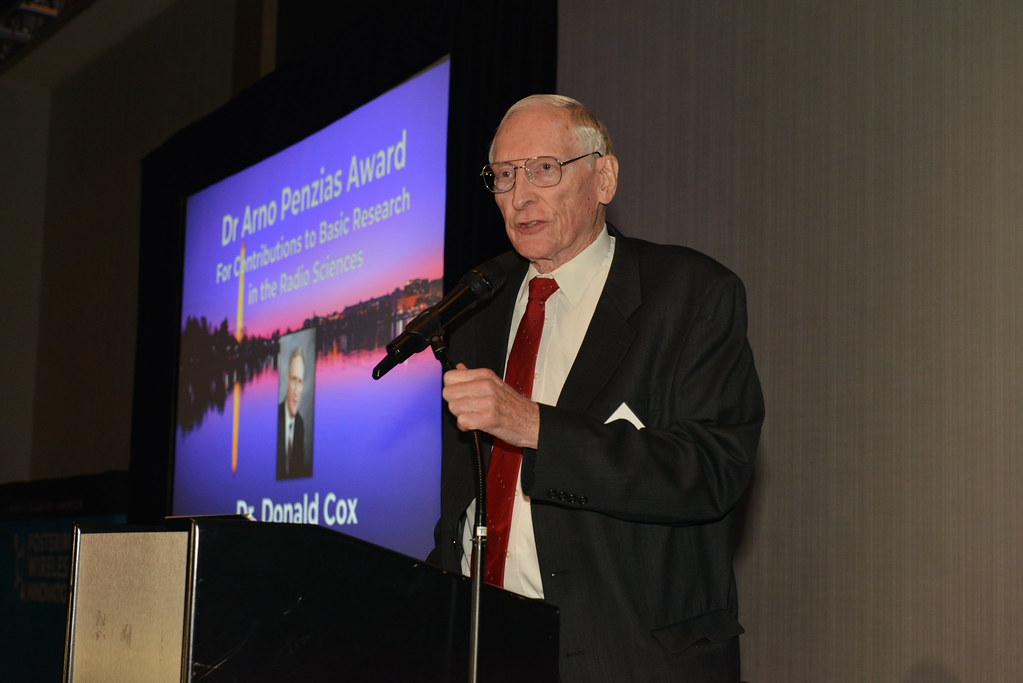
Donald C. Cox, Harald Trap Friis Professor Emeritus at Stanford University, has been named the recipient of the 2025 Arno Penzias Award for Contributions to Basic Research in Radio by the Radio Club of America.
The award honors Cox’s pioneering work in radio science and wireless communications. It is named for Nobel Prize winner Arno Penzias, celebrated for the discovery of cosmic microwave background radiation. For Cox, the recognition carries special meaning.
“The fact I worked with Arno makes it very interesting,” he said. “We were colleagues once upon a time.”
Cox grew up in western Nebraska, attending grade school in Dunning before graduating from Minatare High School in 1955. He went on to earn both bachelor’s and master’s degrees in electrical engineering from the UNL, graduating with distinction in 1959 and 1960.
Following graduation, Cox was commissioned a second lieutenant in the U.S. Air Force. At Wright-Patterson Air Force Base in Ohio, he worked on the DynaSoar project, an experimental winged re-entry vehicle designed to replace capsules with a pilot-controlled aircraft capable of gliding back to Earth.
“It was a re-entry airplane where the frequencies used (12–14 GHz) were way above airplanes,” Cox recalled. The program was shelved in the 1960s, but it offered him invaluable early experience in advanced communication systems.
Cox returned to academia, earning his Ph.D. in electrical engineering from Stanford in 1968 before joining Bell Laboratories in New Jersey where he became a pioneer in the creation of the world’s first cellular telephone system. Later, as executive director of radio research at Bell Communications Research (Bellcore), he helped lead the development of digital wireless personal communication systems that would shape mobile technology for decades.
One highlight of his career was collaborating with Nobel Laureates Penzias and Robert Wilson on millimeter-wave earth-space radio propagation and satellite communication systems. Together, they conducted groundbreaking experiments that advanced both communications technology and radio astronomy.
“These were very unique experiments at the time,” added Cox. “We were building equipment that had to withstand lightning, wind, hail – all types of weather.”
After leaving Bellcore, Cox joined the faculty at Stanford University, where he taught and conducted advanced wireless communications research until his retirement in 2012. That same year, he returned to Nebraska as a visiting professor of electrical engineering at UNL.
Cox’s career has been recognized with some of the highest honors in his field, including the IEEE Alexander Graham Bell Medal (1993), the IEEE Communications Society’s Armstrong Achievement Award (2012), the IEEE Third Millennium Medal (2000), the Marconi Prize for Electromagnetic Waves Propagation (1983), and the Radio Club of America Armstrong Medal (2010). In 1983, UNL awarded him an honorary Doctor of Science degree.
Cox married fellow Nebraskan Mary Alexander in 1961. She earned a Ph.D. in chemistry from UNL, and together they raised twin sons who pursued careers in aviation, law, engineering, and technology.
Outside his professional life, Cox has remained an avid amateur (Ham) radio operator, a licensed pilot, and an early adopter of electric vehicles. A Tesla enthusiast, he raced his Roadsters and Model S sedans in the Sandhills Open Road Challenge in western Nebraska well into his late 70s. “I would call racing Teslas a ‘retirement hobby,’” he joked.
From smalltown Nebraska to the forefront of global telecommunications, Cox’s life’s work has helped make modern wireless communication possible. With the 2025 Arno Penzias Award, his legacy as a pioneer in radio and wireless research is recognized alongside the colleagues and innovations that shaped an industry and changed how the world connects.