
Dean's Message
Welcome to the Winter 2026 issue of ENGINEERING AT NEBRASKA! In this online version we highlight some of the many ways in which our faculty and students participate in entrepreneurship. The College of Engineering’s mission is “to drive economic eevelopment in the state and region while solving problems of global importance.” One way in which we do this is through workforce development. As the only College of Engineering in the state of Nebraska and one of the larger colleges in the region, our graduates are a primary and important source of engineering, construction and computing talent for Nebraska companies and companies throughout the Midwest. Our role in workforce development is why we are striving to grow to a total undergraduate enrollment of 5,000 students, up from approximately 3,000 in 2018 and 3,722 this year.
A second important way in which we support economic development is by producing intellectual property and creating startup companies. This type of economic development is largely driven by the incredible cutting-edge research that our faculty do with support from industry and state and federal agencies like the National Science Foundation (NSF), the National Institutes of Health (NIH) and others.
We have several stories that illustrate the many ways in which the College of Engineering is involved in entrepreneurship and seeking to create a culture of entrepreneurship for all our students and faculty, including Dr. Eric Marvicka, the Robert F. and Myrna L. Krohn Associate Professor of Biomedical Engineering. A Nebraska native, Dr. Marvicka has several federally research projects involving wearable electronics with an emphasis on health care applications. The outcomes of these projects could have a transformative impact in healthcare including the diagnosis and monitoring of diseases, including chronic obstructive pulmonary disease (COPD), and the prediction of athletic orthopedic injuries like ACL tears. There are also significant commercialization opportunities for these technologies as they mature. In order tosupport the commercialization of faculty developed intellectual property and startups, the College has created the Research to Market (R2M) program that seeks to give faculty the skills necessary to take research from the laboratory to the market. Supported by generous philanthropic gifts, the R2M program embeds faculty with recent startups, provideentrepreneurship mentors, and gives faculty additional time to spend on their commercialization efforts. Erick and Dr. Marc Maguire, Associate Professor in the Durham School of Architectural Engineering and Construction, are the inaugural faculty in this first of its kind program.
Also featured online and the cover story for our Winter 2026 edition, we have the story of Joe Flodman and Sip Buddy, Incorporated. Another Nebraska native, Joe is a sophomore in our new Robotics Engineering undergraduate degree program who has a started a company that is building a camera-based drink spiking detection device. If successful, the Sip Buddy device will revolutionize drink spiking detection technology and significantly increase the safety of drinking beverages at public establishments. It is worth noting that Sip Buddy has made extensive use of the Kiewit Hall Design Hub and especially the Tom and Nancy Lauerman Digital Fabrication Lab to make their prototype devices. We are excited to see where this company goes.
Eric and Joe are just two examples of the many ways in which our faculty and students engage in entrepreneurship and drive economic development. We are fortunate to have such talented faculty and students, and I hope you enjoy reading their stories. As always you can reach me at lcperez@unl.edu.

Electrical & Computer Engineering
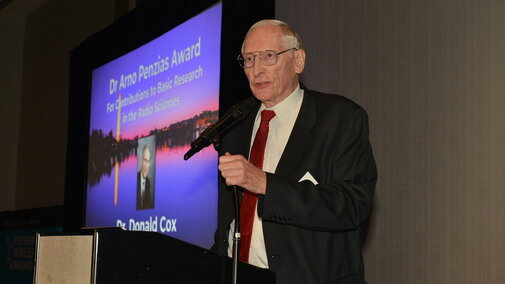
Radio Club of America bestows Donald Cox with 2025 Arno Penzias Award
Donald C. Cox, Harald Trap Friis Professor Emeritus at Stanford University, has been named the recipient of the 2025 Arno Penzias Award for Contributions to Basic Research in Radio by the Radio Club of America.
The award honors Cox’s pioneering work in radio science and wireless communications. It is named for Nobel Prize winner Arno Penzias, celebrated for the discovery of cosmic microwave background radiation. For Cox, the recognition carries special meaning.
Registered Student Organizations
Student Startups Cash in With UNL Pitch Competitions
College of Engineering students who dream of starting a business or developing a product are getting more than just classes and encouragement when it comes to entrepreneurship, they’re earning cash to get their startups off the ground.
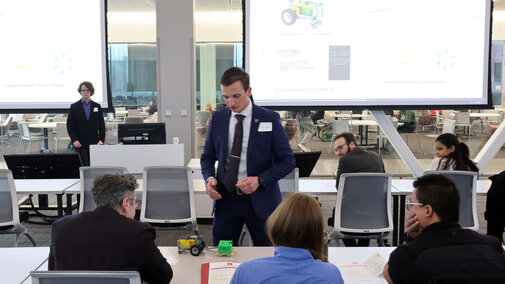
Innovation takes center stage as student-led startups go from idea to competition as students pitch their products to judges from companies like Olsson, HDR, Inc., and Monolith thanks to competitions sponsored by NUtech Ventures, the UNL College of Engineering, and the UNL Center for Entrepreneurship.
Helping students turn ideas into real-world solutions
Engineering students with an innovative spark are exploring how to turn their ideas into viable products or services through Engineering Entrepreneurship, a one-credit-hour course offered at UNL in the fall.
Created in partnership between NUtech Ventures and the College of Engineering, Engineering Entrepreneurship is co-taught by Eric Markvicka, Robert F. and Myrna L. Krohn Associate Professor of Biomedical Engineering, and Joy Eakin, entrepreneurship program manager for NUtech Ventures.

In creating the ‘modern ranch hand,’ Bode charts success with Cattle Kettle
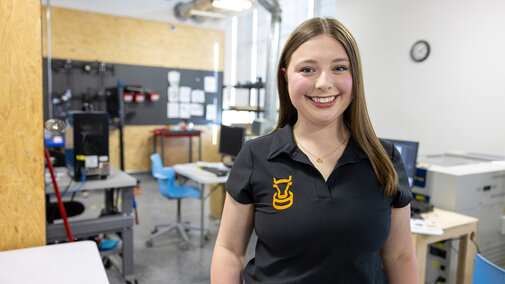
Brooke Bode is banking on her stock tank monitoring device to go out to pasture – and that’s a good thing – as her startup, Cattle Kettle, is bringing innovation to Nebraska’s agricultural landscape.
In 2025, Cattle Kettle won the $3,000 grand prize at the 2025 Engineering Pitch Competition in April and that same month, Bode was honored with the 2025 Student Entrepreneur Award at the 38th Annual New Venture Competition, adding to a growing list of honors for the Hershey, Nebraska native. Bode is CEO and co-founder of Cattle Kettle along with COO and actuarial science major Madelyn Craft. Together, they have presented their stock-tank monitoring device designed to keep cattle hydrated in remote pasture settings at several pitch competitions with a focus on a persistent challenge in livestock management.
Electrical & Computer Engineering
Party Favor: Engineering Student’s Startup Aims to Stamp Out Drink Spiking
A fun night out with friends should never be dreadful. Yet according to new research by LADbible Group and Stamp Out Spiking, 70 percent of young adults ages 18–24 have either experienced or witnessed drink spiking, with more than half of those cases involving women.
That alarming statistic inspired Joseph Flodman, a UNL computer engineering major, to act. Flodman is the founder of Sip Buddy Inc., a startup that’s developing a patent-pending device to help prevent drink spiking and make social outings safer.

Electrical & Computer Engineering
A ‘Nose’ for Innovation: Nebraska Engineering doctoral student developing wearable sensor to detect disease and improve workplace safety through NIH funding
Winter 2026
When Patrick McManigal started as a computer engineering major at the University of Nebraska–Lincoln, he never imagined his future research would involve creating a device capable of smelling disease. But today, the Millard North graduate and entrepreneurial Ph.D. student has developed what he calls an Electronic Nose – a wearable, battery-free sensor that could one day help detect early stages of cancer, diagnose respiratory illnesses, and even keep workers safe from exposure to hazardous chemicals.
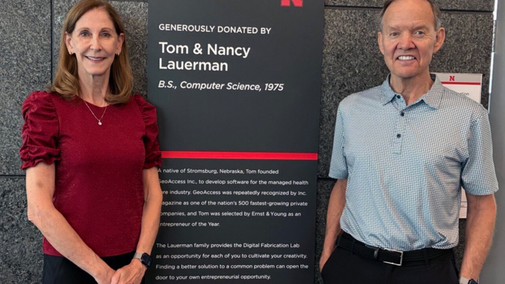
Lauermans make impactful gift to empower the next generation of makers
Winter 2026
The Lauermans’ gift, made through the University of Nebraska Foundation, will be used to equip the new Tom and Nancy Lauerman Digital Fabrication Lab in Kiewit Hall.
Nebraska Engineering launches Robotics Engineering major
Winter 2026
A first-of-its-kind undergraduate major in robotics engineering is now part of the College of Engineering curriculum, marking a milestone in the college’s commitment to hands-on, interdisciplinary education. The Bachelor of Science in Robotics Engineering began enrolling students fall of 2025 and it merges coursework and faculty expertise from mechanical and electrical engineering, computing, and agricultural systems.
