Go big infrared: Husker imaging system streamlines analysis of seeds

February 3, 2022

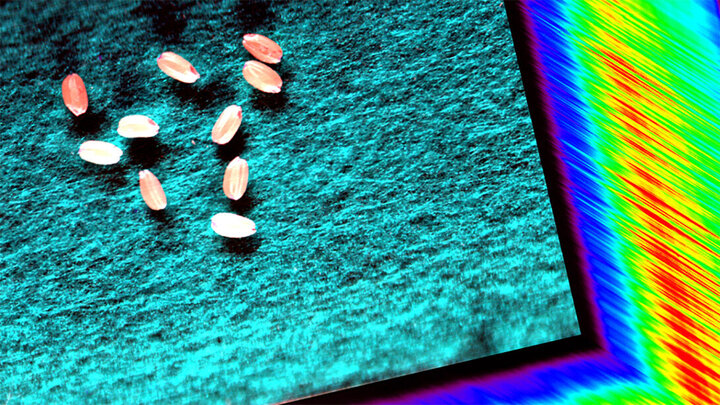
A close-up of a hyperspectral data cube, or hypercube, a form of data readout that captures both the 2D spatial dimensions of seeds and a range of wavelengths reflecting from those seeds.
A close-up of a hyperspectral data cube, or hypercube, a form of data readout that captures both the 2D spatial dimensions of seeds and a range of wavelengths reflecting from those seeds. Husker researchers have developed a new imaging system, HyperSeed, that uses infrared wavelengths to analyze the traits of grains produced under the stresses of heat and drought.
Hongfeng Yu and Tian Gao / Adapted from figure in Sensors

To observe traits that can’t be easily seen, Husker researchers have turned to the wavelengths that can’t be, either.

The University of Nebraska–Lincoln’s Hongfeng Yu, Tian Gao and Harkamal Walia have developed a new imaging system that could help capture the nutritional value of seeds from myriad crops by first capturing the invisible wavelengths reflecting from them.

Share This Article