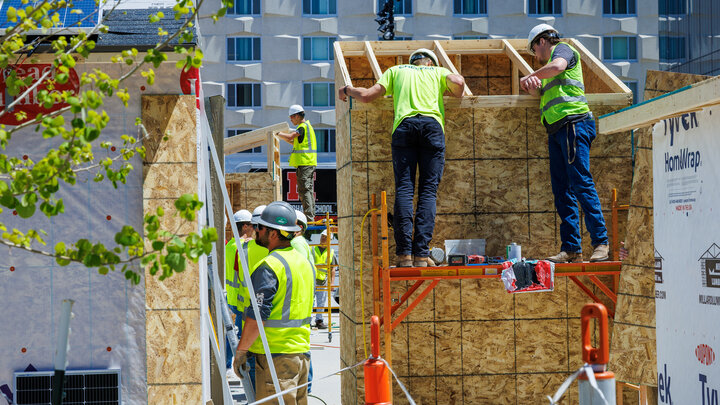
Kiewit Hall’s outdoor patio will be a “hardhat zone” for a week beginning Monday, April 27 as 115 students in Emmeline Watson’s CNST 242: Vertical Construction course, a project-based learning class, build 11 sheds to raise funds for Habitat for Humanity.
It’s the second year of “Sheds for Hope,” a community-engaged construction project where students gain real-world experience framing walls and floors, installing roofing systems, siding, windows and doors – and doing it all for a good grade and a better cause.
“For students, it’s about doing hard things in a safe environment,” said Watson, assistant professor of practice in the Durham School of Architectural Engineering and Construction. “Not only do they build in a structured environment together, but they work as a team learning from other engineers and industry partners what it takes to manage a construction project.”
Watson teaches students what a 2-by-4 is and what treated lumber is used for, but a big part of what she wants students to know is the importance of engaging their community and giving something back. For some students, it’s an opportunity to take their construction skills to the next level. For others, it might be the first time they’ve used a nail gun or power saw.
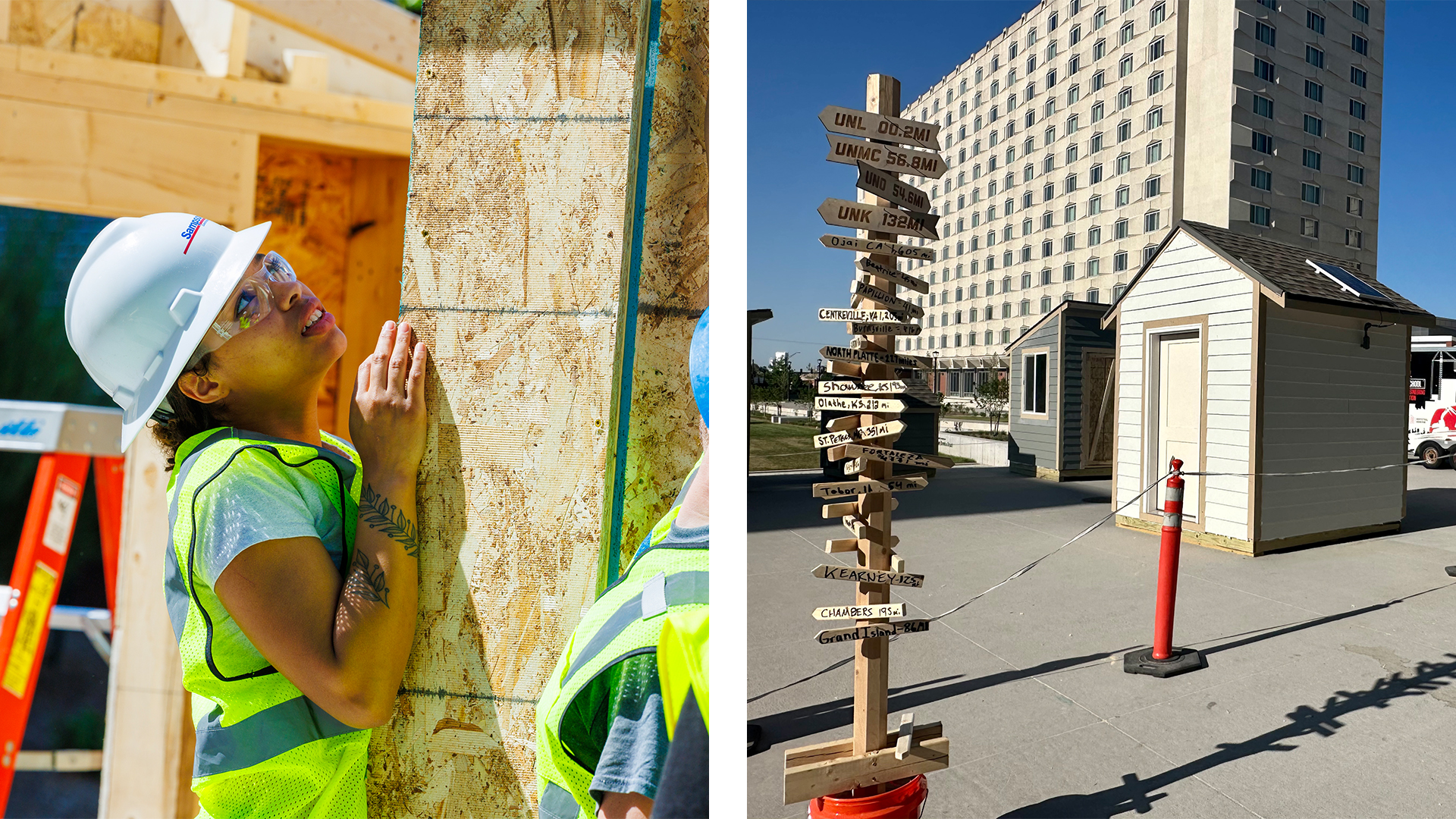
“I enjoy a project like this as much for myself as I do for class,” added Vince Grenier, a senior construction management student from Omaha. “Everyone’s being trained regardless of experience on safety and knowing how to use power tools. You shouldn’t be managing a construction project without knowing the basics of using power tools.”
Watson credits her Cook Teaching Fellowship for the growth of Sheds for Hope and its impact on the college. The Cook Fellowship is part of a professional development series in the College of Engineering designed to strengthen teaching through peer learning, feedback, and research-based practices.
“Engineers like to see things get built,” Watson said with a smile. “And, with a project like this, there’s no better feeling than showing off what we’ve accomplished. Students are proud of what they’ve done, and a lot of students last year brought their parents to Kiewit Hall to show what they did.”
Following the success of Sheds for Hope, Watson says many students, along with industry partners like Watts Electric, Pella Windows and Doors, BluCor Construction Group and Millard Lumber will help build homes for Habitat for Humanity in Nebraska City this summer.
“This is a multidiscipline, very collaborative project that I am very grateful for and we have so many partners who contribute their time and resources,” Watson added, noting that last year’s sheds – each planned with a large window and a solar panel on the roof – raised about $10,000, and the 2026 build will aim to match that impact.
For more details about “Sheds for Hope” and to follow its progress, visit https://watsonlab.unl.edu.