Artificial intelligence is rapidly reshaping how the world works — and at the University of Nebraska–Lincoln, College of Engineering faculty and students have been leading that shift for decades.
As AI’s influence increases, so do the questions surrounding its responsible use in education, research and the workforce. Those questions were front and center on Thursday, Feb. 5 as the college publicly launched the Prairie Initiative, a new effort to connect students, faculty, staff and industry partners around best practices for ethical and effective AI integration.
“AI has taken on a new life,” said Lance C. Pérez, Fred Hunzeker Dean of Engineering. “UNL has a tremendous advantage — an ecosystem built over decades that positions us to lead in responsible AI.”
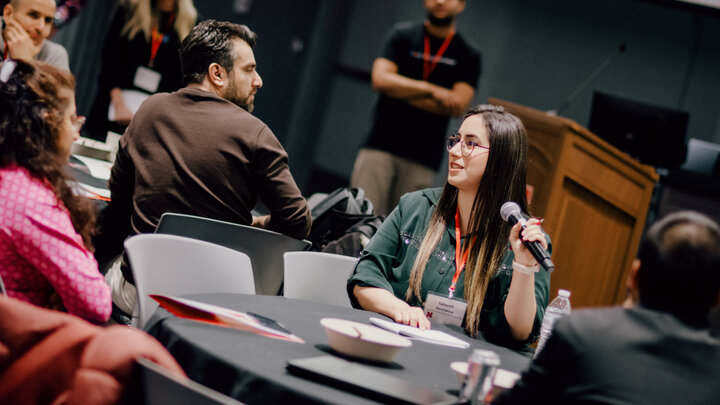
Nearly 150 people attended a panel discussion that included leaders from Google, MathWorks, Bayer Crop Sciences, Nelnet, the College of Business and the College of Engineering to learn how they’ve experienced AI reshaping industries, workflows and the skills college students will need after graduation.
Among those skills necessary is establishing a trusting relationship with AI and using it as part of the collaborative process. Hilary Kasel, an account executive at Google Public Sector, said perceptions of the technology and its applications is key to responsible use.
“A lot of people have never seen these types of tools, so it’s teaching about what they are and letting (workers) know the tools – building trust in the basic skills and making sure they use this as a collaboration tool to make you more productive and not look at it as something that will replace your job,” Kasel said.
“Part of that is making sure people know they can trust these tools and educating them around that.”
Afternoon workshops focused on three topics – how AI is transforming the research landscape; practical AI applications for everyday work; and the future of AI in course design, academic integrity and preparing students for an AI-enabled world.
As a panelist for the discussion, “The Future of Work in an AI-Transformed World,” Jean Claude Niyomugabo offered a holistic perspective. As a student, a researcher and a consumer, Niyomugabo said he understands that the landscape in the world of AI is constantly evolving and believes the confidence of those who use AI must change along with it.
“Trust is one of the challenges affecting many of us. As a student, I’ve been able to see that it’s better for us to learn fundamentals, the traditional knowledge,” said Niyomugabo, a master’s degree student in agricultural systems technology. “So, when you need to leverage AI, maybe you know the fundamentals will help you.”
Pérez said the launch event was just a small step for the Prairie Initiative but anticipates it will be a giant leap forward with long-lasting impact that reaches beyond campus and the state.
The initiative is already delivering programming for students. In Fall 2025, the college launched two new courses to build AI skills across all engineering disciplines, and the new Husker AI student organization is providing a community for students to explore AI together. And the AI Makerspace, powered by a partnership with Scott Data Center in Omaha, gives students and faculty access to dedicated GPU resources and computational infrastructure essential for AI development.
"AI is transforming how we learn, teach, discover and solve problems," said Mark Stone, director of the Prairie Initiative. "We're preparing students to responsibly and creatively use AI in engineering, computing and construction, and we're inviting the greater community to help shape how and what this initiative becomes."
New degree pathways are also expanding options for students at all levels. The School of Computing offers an undergraduate minor in Artificial Intelligence and an AI graduate certificate, with a Master of Science in AI launching in 2026.
“Our faculty have been working in the AI space for three decades, and across the university we have numerous faculty, staff and students who are engaged and are used to having thoughtful discussions about difficult issues,” Pérez said. “The Prairie Initiative builds on the culture of Nebraska, which has long been a leader in the country in the responsible use of technology.
“With any technical revolution, there's always a chance you leave people behind, and we don't want that to happen in Nebraska or the United States. We want to get everybody engaged and to make sure that everybody has the skills they need and the knowledge they need to use AI responsibly.”