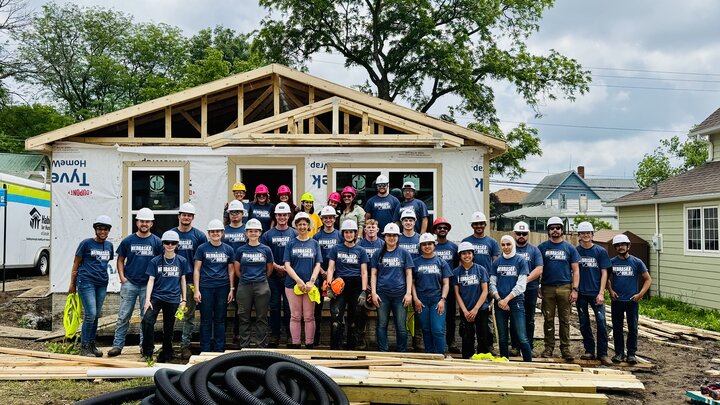
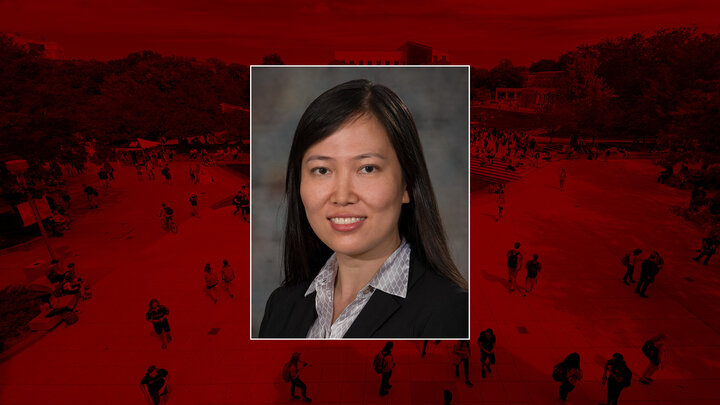
In July 2026, nine additional College of Engineering faculty were awarded named professorships. The college now has 38 endowed professorships at the professor and associate professor level. Seven additional faulty hold professorships awarded by the university, including two announced this summer.
An endowed professorship is the highest academic honor the college can bestow on a faculty member and is also a tribute to those who fund them.
Funds for the professorships are provided by private gifts to the University of Nebraska Foundation to support current and new distinguished faculty in the College of Engineering. The income from these professorships provides stipends to support competitive salaries and collaborative research, and to help recruit and retain key faculty in support of the college’s overall mission and strategic direction.
“We are fortunate to have many generous donors who recognize that outstanding faculty are essential to providing engineering students with a Big Ten education and to advancing the reputation of the college and the university,” said Lance C. Pérez, Fred Hunzeker Dean of Engineering, “We are very grateful for their support. Without it we would not be able to attract and retain such talented faculty.”
The newly named professorships from the college include:
Florin Bobaru, Robert W. Brightfelt Professor of Engineering (Mechanical and Materials Engineering) works on computational models that predict dynamic fracture, fragmentation, corrosion, and heat and mass diffusion in complex systems. His peridynamic models for impact fracture in glass, glassy-polymers, polycrystalline ceramics, and fiber-reinforced composites have achieved global recognition. He has received grants or worked with such agencies as the National Science Foundation, Department of Defense, National Institute of Standards and Technology, industry, and NASA.
Piyush Grover, Richard L. & Carol S. McNeel Associate Professor of Mechanical and Materials Engineering, develops mathematical methods for analysis, control, and reduced-order modeling of nonlinear dynamical systems, focusing on uncovering and exploiting mechanisms governing instability, transport, collective behavior, and dynamical transitions across diverse natural and engineered systems. His work spans active fluids, mean-field control, multi-agent robotics, and mechanical metamaterials, and is funded by the National Science Foundation, Department of Energy, and Department of Defense.
Abdelghani Laraoui, Leonard A. Lovell Associate Professor of Mechanical and Materials Engineering, advances quantum materials based on diamond color centers and defects in semiconductors and two-dimensional materials for quantum sensing and information processing. His work spans quantum sensing, defect discovery and spectroscopy, spintronics, and nanophotonics, enabling next-generation quantum devices and scalable optical and spin-based networks. He has received funding from the National Science Foundation within ExpandQISE, EPSCOR, and DMR programs.
Eric Markvicka, Robert & Myrna L. Krohn Associate Professor of Biomedical Engineering, focuses on engineering electronics and machines that replicate the mechanical compliance and adaptability of biological systems. His work involves pioneering new classes of soft multifunctional materials and manufacturing techniques. He is a senior member of the National Academy of Inventors and a National Strategic Research Institute Fellow, a 2024 NSF CAREER Award recipient, and was named a 2024 ASME Rising Star of Mechanical Engineering.
Grace Panther, John E. Olsson Associate Professor of Civil and Environmental Engineering, is a discipline-based education researcher in engineering education, with a focus on studying practicing engineers in the workplace and developing key competencies of undergraduate students including inclusive teamwork skills, de-spatializing the curriculum, and metacognition. She is the recipient of a National Science Foundation CAREER award.
Tirthankar Roy, John E. Olsson Associate Professor of Civil and Environmental Engineering, spans interdisciplinary topics in hydrology, including AI/ML applications, hydrologic processes across scales, hydrological extremes, human-water systems, water and agriculture, and water and public health. His work has been supported by the National Science Foundation, NASA, National Oceanic and Atmospheric Administration, USDA, Department of Defense, and state agencies.
James E. Stine is the inaugural Jim & Gale Anderson Professor of Electrical and Computer Engineering and the newly named department chair after working at Oklahoma State University for 21 years, most recently as Edward Joullian Endowed Chair and Professor. He advances computation through digital logic, high-performance arithmetic, and scalable computer architectures. His research spans computer arithmetic, floating-point implementations, VLSI and FPGA design, memory architectures, and cryptographic accelerators. He co-leads Wally, an open-source RISC-V System-on-Chip platform that expands access to advanced chip design and verified silicon implementation. He has collaborated with organizations such as Google, NASA, AMD, the National Science Foundation, and the Air Force Research Laboratory.
Professorships awarded from the University of Nebraska-Lincoln include:
Named a recipient of the University of Nebraska-Lincoln Aaron Douglas Professor of Practice in Engineering, Jena Asgarpoor’s focus is on engineering management education, including quality management, pedagogy, and assessment of teaching and learning, especially in online settings. Asgarpoor is director of the college’s Master of Engineering Management program and has provided national leadership and service to ASEM as president, and to ASEE’s Engineering Management Division as secretary, treasurer, program chair, chair, and past chair. She is also a Certified Professional in Engineering Management.
Bonita Sharif, associate professor in the School of Computing, has been awarded the university’s Susan J. Rosowski Professorship. She is a leading researcher at the intersection of human-computer interaction and software maintenance, with a particular focus on eye-tracking in software engineering. Her signature contribution is iTrace, a community eye-tracking infrastructure for software engineers and education researchers to conduct realistic studies on open-source systems. She has received an NSF CAREER Award and a Computing Research Infrastructure grant. She is also a founding board member of Girls Code Lincoln.